
Shree Raj Diamonds & Jewelry
Indian rupee (₹) - INR
-
Indian rupee (₹) - INR
-
United States dollar ($) - USD
-
Euro (€) - EUR
Shree Raj Diamonds & Jewelry

Get personalized guidance from our diamond specialists 24/7.
Exchange your product within 30 days with a smooth and simple process.
Your transactions are encrypted and secured for complete confidence.
Yes, all our diamonds come with international certification (GIA, IGI, or equivalent), ensuring authenticity, cut, clarity, color, and carat accuracy.
Absolutely! We specialize in creating custom diamond jewellery. Share your design ideas, and our experts will help craft your dream piece.
Yes, you can visit our store or request high-quality images/videos of the diamond before making a decision.
All diamonds undergo strict testing and certification, ensuring authenticity and quality. You can also verify the diamond certificate online.
We offer both 100% natural diamonds and eco-friendly lab-grown diamonds.
Customers can choose based on their preference, quality requirements, and budget.
We accept multiple payment options, including cash, credit/debit cards, UPI, and bank transfers.
Our secure payment system ensures a smooth and safe checkout experience.
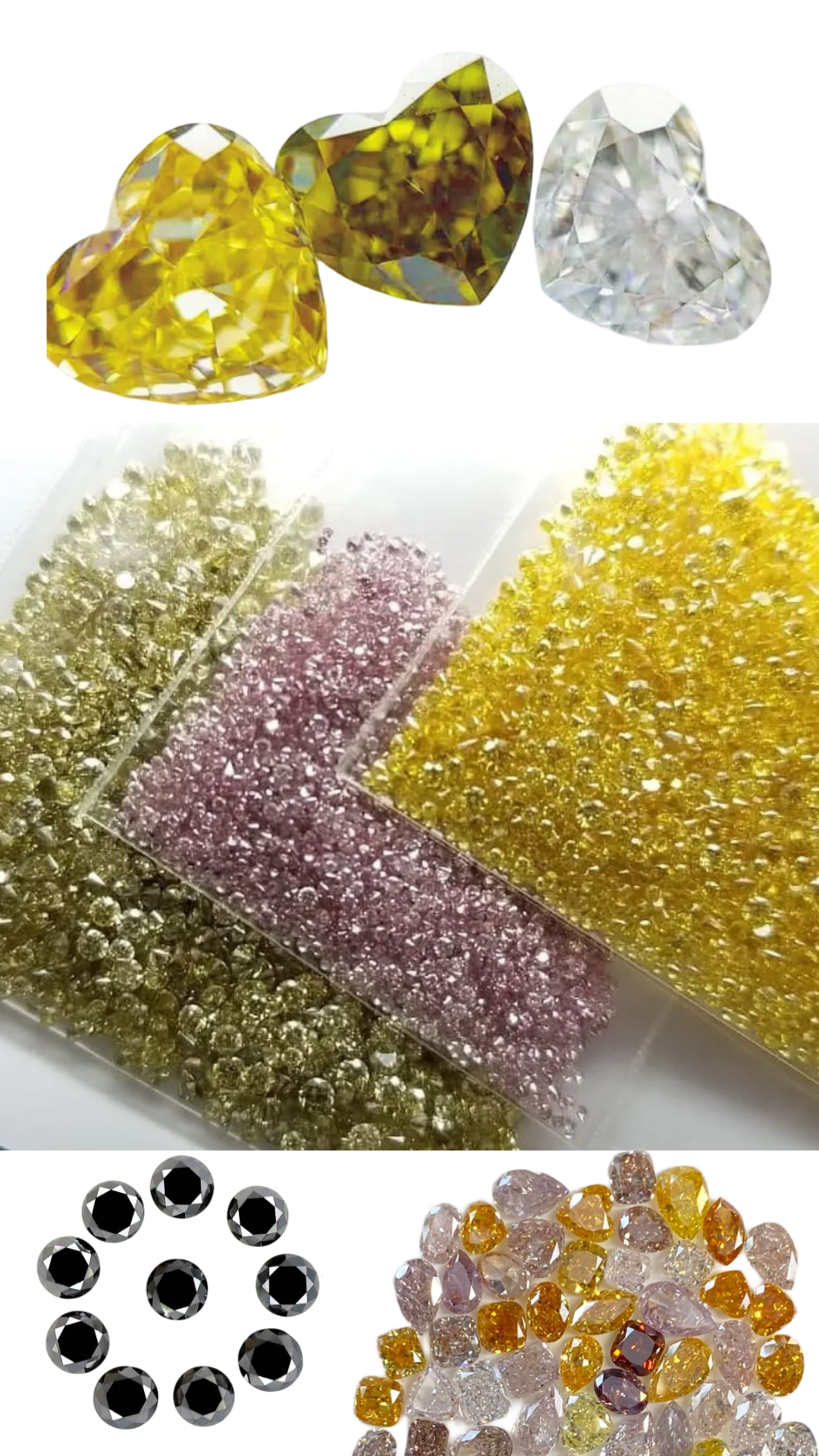
The opaque color of black diamonds is caused by dark inclusions or, more commonly, by color treatment. Most black diamonds are treated to become a green that’s so dark it appears black, but not opaque.
When a diamond falls outside of Shree Raj Diamond’s D-to-Z color scale, it is considered a colored diamond (sometimes called a fancy-color diamond). This includes all colors other than colorless to light yellow or brown. On Shree Raj Diamond Colored Diamond Grading Reports, colored diamonds are graded in order of increasing color strength, from Faint, Very Light, Light, Fancy Light and Fancy to Fancy Intense, Fancy Vivid, Fancy Dark and Fancy Deep. Fancy Intense and Fancy Vivid generally command higher prices.
Colored diamonds are usually cut to maximize the intensity of their color rather than to maximize light return. The best cut is one that gives the most attractive face-up color.
Most diamonds used in jewelry range from colorless to light yellow and are graded on a scale from D (colorless) to Z (light yellow). Those with less color, or closer to colorless, are generally more valuable. Diamonds with deeper shades of yellow (more color than Z) are graded differently and given a fancy-color grade. For these colored diamonds, a more vibrant color typically means higher value.
The number of facets affects the pattern of the reflections in a diamond rather than overall brightness. Diamonds with more facets have numerous smaller reflections instead of fewer larger reflections. Brightness is a function of proportions, polish and symmetry, not the number of facets.
Yes. The Shree Raj Diamond Cut Grading System, introduced in 2005 after years of extensive research, assigns one of five grades to describe the overall cut quality of a standard round brilliant diamond in the GIA D-to-Z color range.
You can send your diamond to Shree Raj Diamond for grading and analysis. Many consumers send the diamond through a retailer for packaging, shipping and insuring the item. A jeweler will have to remove your diamond from its setting, since Shreee Raj Diamond Grading Reports are only issued for unmounted stones.
Most diamonds used in jewelry range from colorless to light yellow and are graded on a scale from D (colorless) to Z (light yellow). Those with less color, or closer to colorless, are generally more valuable. Diamonds with deeper shades of yellow (more color than Z) are graded differently and given a fancy-color grade. For these colored diamonds, a more vibrant color typically means higher value.
In 2002, a coalition of governments, non-governmental organizations and the diamond industry established the Kimberley Process to control the export and import of rough diamonds to eliminate the trade in conflict diamonds. Today 99% of diamonds in the marketplace are conflict-free.
In 2002, a coalition of governments, non-governmental organizations and the diamond industry established the Kimberley Process to control the export and import of rough diamonds to eliminate the trade in conflict diamonds. Today 99% of diamonds in the marketplace are conflict-free.
Unbeatable steals and deals, just for today! Don't miss out on our daily specials at ShreeRajGroup. Grab your favorites before they're gone.
